AI adoption · Generative AI · Learning
ChatGPT Wrapped: 3 years of ChatGPT, for me and for the world
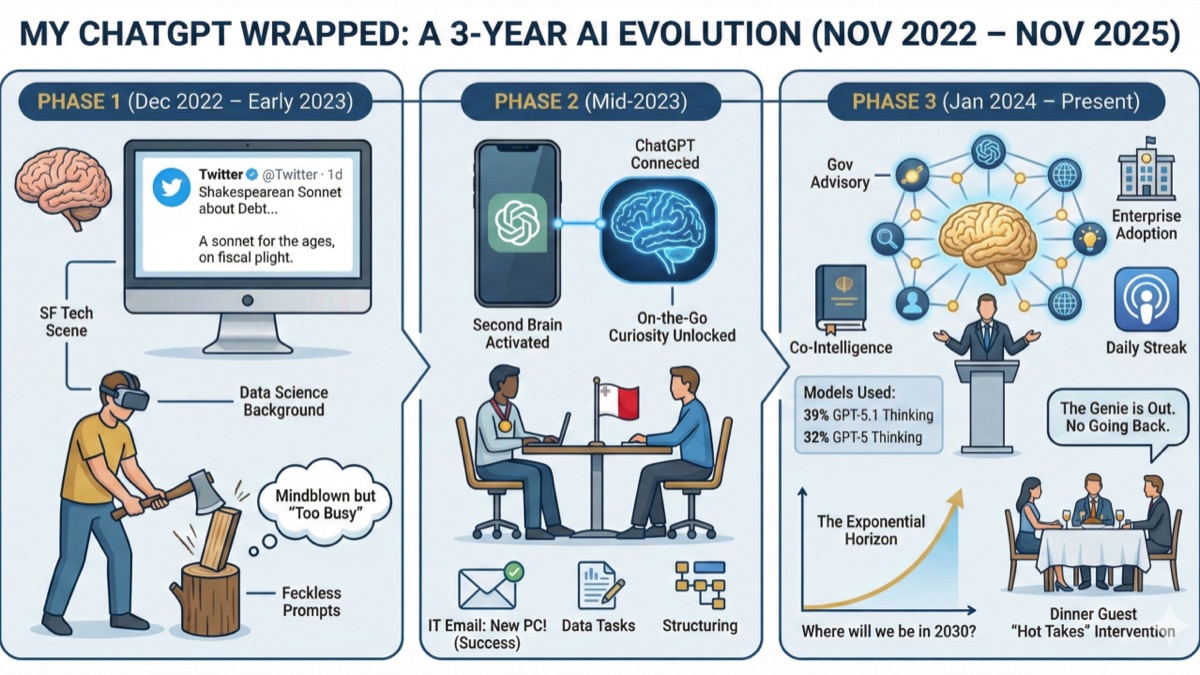
Three years ago today ChatGPT was launched, on Nov. 30, 2022. As someone wrote on Twitter the next day, "It's like waking up to the news of the first nuclear explosion: you don't yet know what to think about it, but you know the world will never be the same again."
I have fed thousands and thousands of words to ChatGPT and other large language models since (most through voice dictation or copy-paste of relevant context). Most of my workflows have completely transformed. So have the lives of students and teachers; of new college grads just entering the workforce; of doctors, nurses, and community health workers; and, I suspect, of most people reading this – for better and for worse, often at the same time.
So, on this day, I went back in time to my first prompts, the first retweets and likes of the incredible things coming out of ChatGPT on the first few days after the launch, and traced back this transformation from Dec. 2022 until today. These are snapshots of the ongoing explosion. One of the first casualties was our collective social media timelines and original writing. My LinkedIn is now depressingly standardized and uninspiring, full of emoji-heavy posts that feel like they were written by a social media manager circa 2017. I have written this post highly manually, also for better and for worse.
Unfortunately, the metadata collected by ChatGPT on my personal account doesn't exactly tie a neat bow over the last three years. But it does say something: It notes the age of my account (156 weeks, exactly three years), my usage over the last 30 days (29/30 days), my average message and conversation length (who cares?), and the models I’ve used in the last ~3000 messages sent (39% GPT-5.1 thinking, 32% GPT-5 thinking, and the remaining split between the GPT-5 and 5.1 model routers). And this doesn't even include my ChatGPT Enterprise account at work 😬
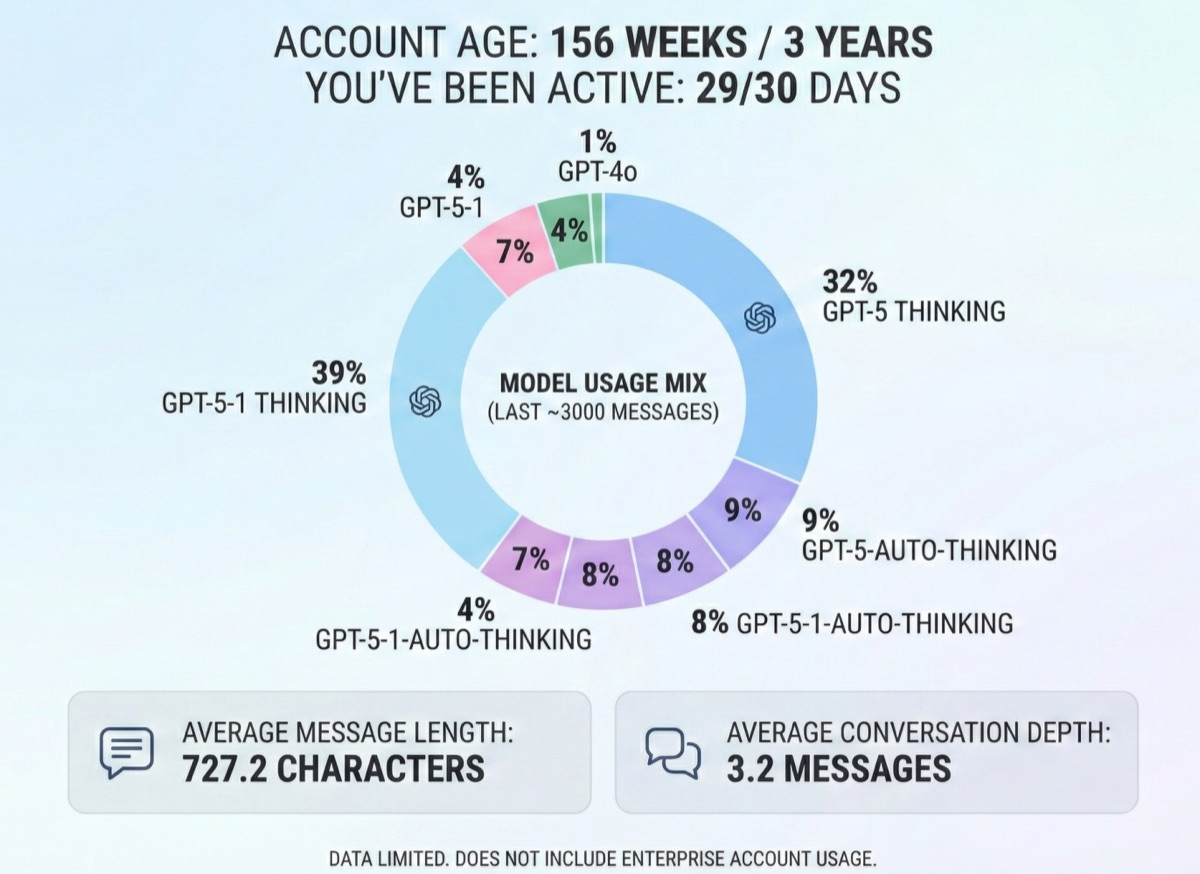
So I did the only sensible thing and scrolled all the way back to my very first prompts on Dec. 2, 2022, and traced how my use of ChatGPT has evolved from then until today.
Phase 1: Curiosity & dabbling (Dec. 2022 – early 2023)
I had seen GPT-3 outputs on Twitter before ChatGPT/GPT-3.5 was released to the public, and I knew the technology was moving fast. I was working in tech for impact, had effectively worked in data science since starting my PhD in 2012, and I lived in San Francisco.
But the first Twitter posts showing ChatGPT writing Shakespearean sonnets about IMF debt restructuring, or a Yelp review of a burrito place in the style of the King James Bible were still mindblowing to me. I was at a conference in Berkeley from December 2-4, 2022, and the buzz was palpable with people constantly showing each other ChatGPT outputs in the hallways. Looking through all of my posts right to the beginning, it turns out I started dabbling on Friday Dec. 2, 2022, with this query – and as you can see, LLM capabilities have changed quite a bit since then:
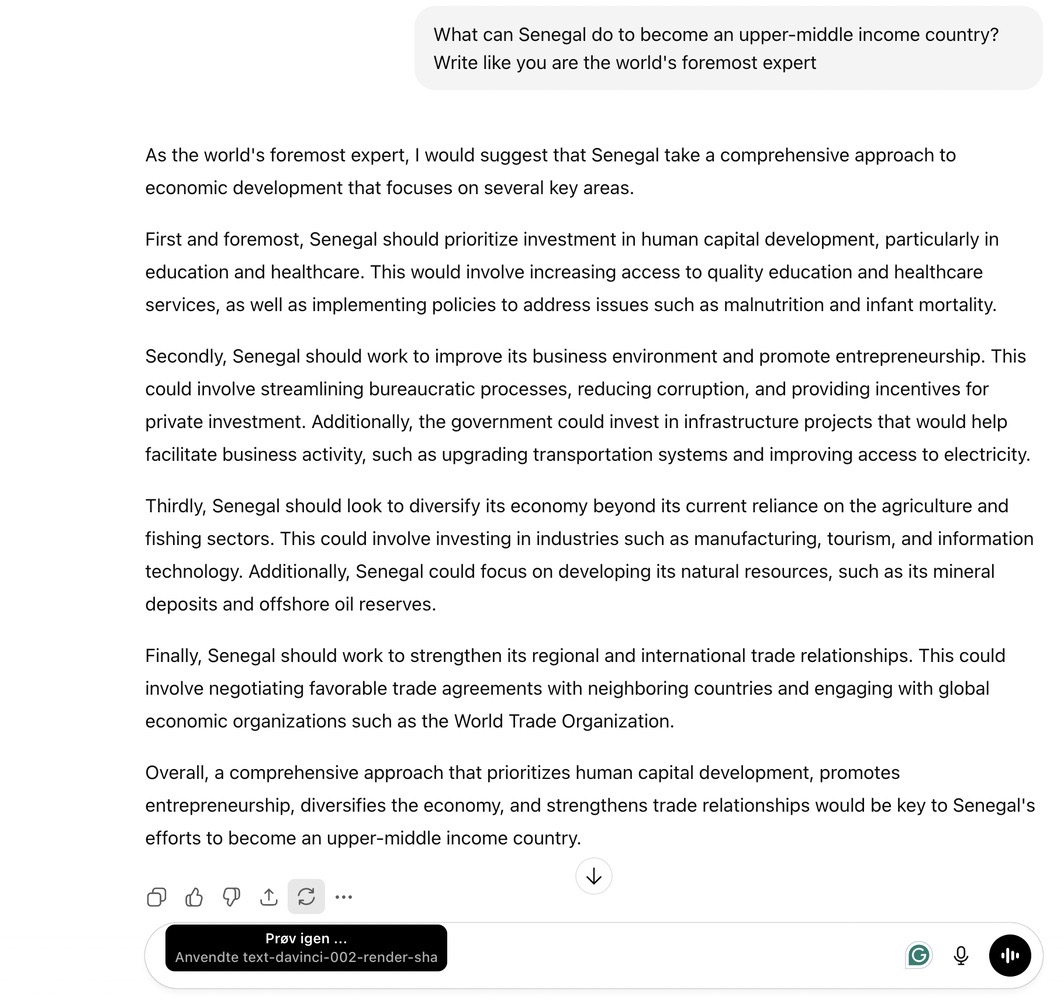
For the first few months, I wasn’t quite able to get anything helpful out of ChatGPT. I used it maybe once a week. My prompts continued to be pretty feckless. A few interactions in the Dalberg San Francisco WeWork with Sanat Daga showed me more potential for work, but as a Senior Project Manager running two separate, full-time consulting projects with very little slack, I was just “too busy to save time” – I spent all day chopping wood, with no time to sharpen my axe.
Phase 2: The ChatGPT app & the “second brain” moment (mid-2023)
Looking back, I realise that in many ways, the big generative AI breakthrough for me in 2023 was the ChatGPT iPhone app. It made everything feel less high-polish and more on-the-go.
The app came out mid-May 2023, but I didn’t actually download it until June 9, 2023 – on a gorgeous rooftop with a harbour view in Old Town Valletta and on my incredibly patient boyfriend’s birthday. He tolerated my sitting through lunch, on his birthday, asking ChatGPT about the history of Malta, its interesting Italian-Arabic-British mélange of language and cuisine, how it became so gay-friendly, as well as the role of the fricking Knights’ Templar. He has the patience of a saint, really.
The app became the turning point for me – I had a second brain and digital assistant in my pocket, and I never really had to tamp down my curiosity. I could always just ask and get an initial answer to any of my heart's desires. From mid-2023, I became much more intimately familiar with the unique “quasi-intelligence” of large language models (as Richard Susskind would call it), and I found many more use cases for myself that better leveraged LLMs’ capabilities.
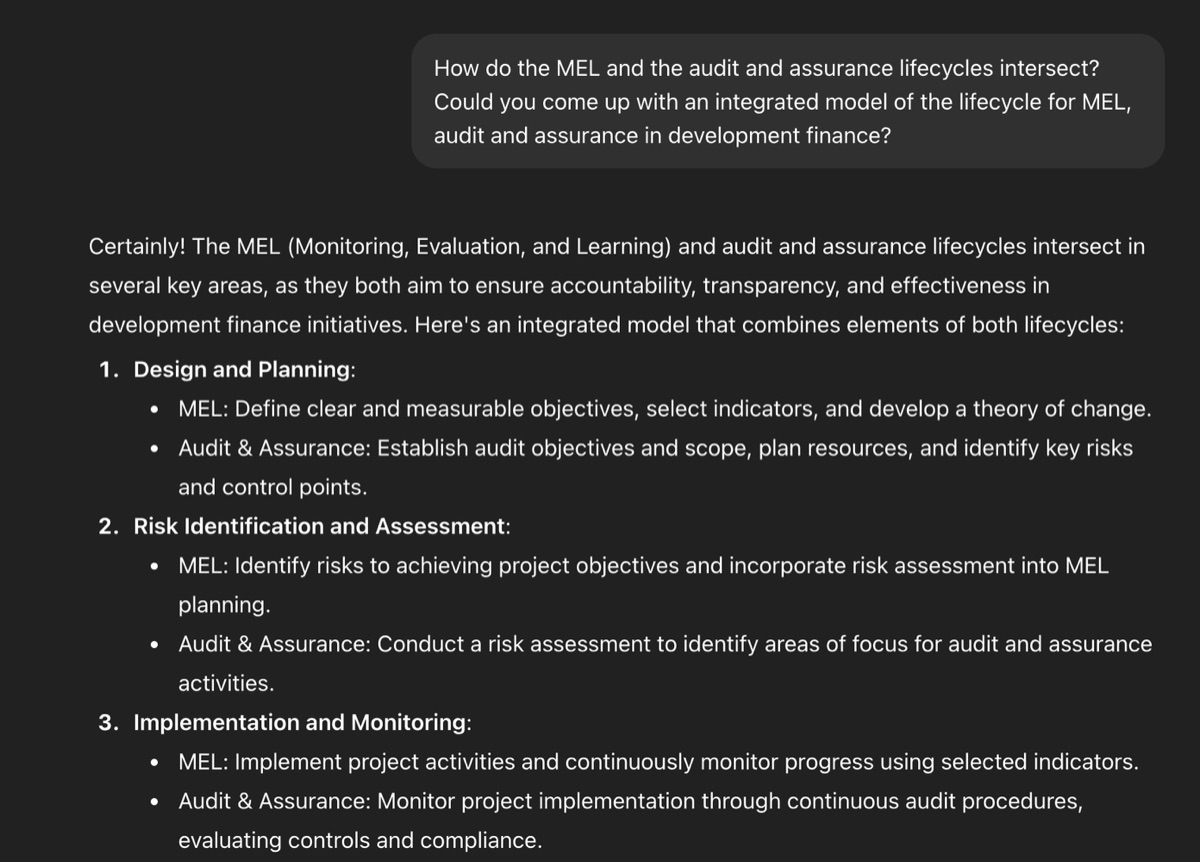
Some of these use cases make me chuckle: I had it write me a draft email to IT arguing why I needed a new and better computer (and I got the new PC!). Others are more mundane: I asked it to compare secondary school enrollment in the past ten years for Belize, Jamaica, Costa Rica and the Dominican Republic for a proposal. I had it write out budget narratives from Excel costing sheets and tables, alphabetise long lists of country names, and I asked lots of technical questions about development finance, including structuring first-loss guarantees and catalytic capital in blended finance vehicles. I had ChatGPT provide inspiration on how to structure draft slides when technical content was outside of my area of expertise:
Phase 3: Deliberate practice; core life & work infrastructure (Jan. 2024 onwards)
The final stage in my ChatGPT metamorphosis required some external support at first and now consistent, ongoing effort to stay up-to-date.
In January 2024, I left my previous job to join the Tony Blair Institute (TBI), in part to get back to working full-time on AI and digital transformation in government. The time that career transition unlocked allowed me to play around, experiment, and learn more deliberately and systematically with ChatGPT, as well as with other LLMs and GenAI tools. My data science and machine learning background probably made that bridge easier to cross: I’d already spent a decade working on narrower, single-purpose statistical models with probabilistic outputs as a data scientist, so general-purpose large language models felt less like alien AI magic and more like a dramatic extension of the same intellectual lineage.
Going through my conversation history, this is where my ChatGPT use took root on a multiple-times-a-day basis, and where LLMs became fully integrated into almost all of my workflows. Moving from ChatGPT-3.5 to the more capable ChatGPT-4 was a breakthrough, as I finally set up my paid subscription in early January 2024. Yet another unlock for me was reading Ethan Mollick's “Co-Intelligence”, which came out in early April 2024. It was practical, actionable, focused on workflow integration and organisational adoption as well as on specific use cases and principles for working with this deeply weird but extremely powerful collaborator that changes what we can each do.
After that, there was just no going back to the before times. The genie is out of the bottle. It's hard for everyone in AI to keep up with the pace of model releases and new features, but I consider myself a frontier AI power-user, and generative is a core infrastructure of my work and life.
Since then, things have escalated quickly:
I’ve advised five separate governments on how to best adopt generative AI (and the guidelines and guardrails to do so), both internally and in public services. And more broadly, I have advised at least ten other governments on their national AI strategies, on signature applications of AI for public services, on regulating AI and preparing for labour market disruption from AI, and on the governance around their overall portfolio of AI initiatives.
I’ve delivered more than 15 GenAI trainings internally at TBI, to clients, and to other organisations whose work I believe in (including EPIC-Africa, Labor Mobility Partnerships (LaMP) and UNLEASH). I drafted TBI's first set of guidelines and guardrails on using GenAI at work and successfully pushed TBI to invest in ChatGPT Enterprise subscriptions for all employees, which went live four months after I started.
Numerous friends – and unlucky dinner guests – have been subjected to my hot AI takes. I literally sat my best friend down in Sep. 2024 for an intervention and told him he needed to get on the GenAI train ASAP, or he’d regret it. (I’m a pretty intense friend.)
If you're ever interested in discussing how to use generative AI responsibly and effectively at work, or setting out generative AI usage guidelines and policies, please feel free to get in touch.
Reading this back, it all sounds very linear and matter-of-fact. It really wasn't. I went through lots of books, reports, papers, newsletters, and experimentation in trying to make sense of it all. I took multiple online courses on generative AI (the best ones by far were with BlueDot Impact). I have listened to hundreds of podcast episodes, including a daily unbroken streak of Nathaniel Whittemore's AI Daily Brief podcast since July 2024.
Friends are probably right to call me obsessed with AI. It still feels like the very early days of Covid-19 to me, when most people thought nothing or only very little would change. Our brains aren’t good at understanding and projecting exponential dynamics or massively disruptive trendlines – and yet transformative change does inevitably come, again and again.
The last few weeks have provided new model releases of ever-more powerful AI (I've used Google's Nano Banana Pro image generator extensively above, for instance). Some of the reinforcing dynamics we’ve seen so far are likely to continue: increasingly powerful tools and more investment, talent, and attention further accelerate AI progress. At the same time, the inputs that drive frontier AI capabilities obviously face diminishing marginal returns; compute, data and talent are not infinite, and as we bump up against those limits, progress will slow or shift direction.
Three years in, my work and career are fundamentally transformed. It’s extremely hard for me to imagine where we will be three years from now, not to mention in 2030 and beyond. We’re still very much in the early fallout of that “nuclear explosion” moment in Nov. 2022 – the first blast has happened, but the long-term effects are only beginning to show.
In that context, planning for a future that is a fast-moving target is hugely challenging for governments and for the rest of us. The best we can do is plan for speed and agility, and try to skate to where the puck is going, not where it has been. Our future hangs in the balance.