Christian and Muslim regions are similar.
Muslim-majority countries are less often democracies. Inside 36 African countries, however, Muslim-majority regions are rated as democratic as their neighbours.
This research is from my 2016 PhD dissertation, was never published, and has not been updated since. Later events and studies appear only where marked.
Across the world, countries with Muslim majorities are less often democracies than countries with Christian majorities. One explanation puts the cause in ordinary believers: Islam, on this view, breeds a political culture that is apathetic about democracy or hostile to it. If that were right, the gap should also open between regions of the same country, where Muslims and Christians live under one national state and deal with its officials every day.
Using 189,000 interviews from 492 regions in 36 African countries, I find that it does not. Regions with many Muslims are rated about as democratic as regions with few in the same country. Muslims want democracy as much as their Christian neighbours, and know more about who governs them.
Whatever holds back democracy in Muslim-majority countries seems to work through states, their histories and their alliances. Religious minorities living in Muslim-majority regions give a less comfortable answer, and that is part of the result.
Written largely by Claude and reviewed by me. How this was made
Original textDissertation chapter 7, 2016 (PDF) ↗
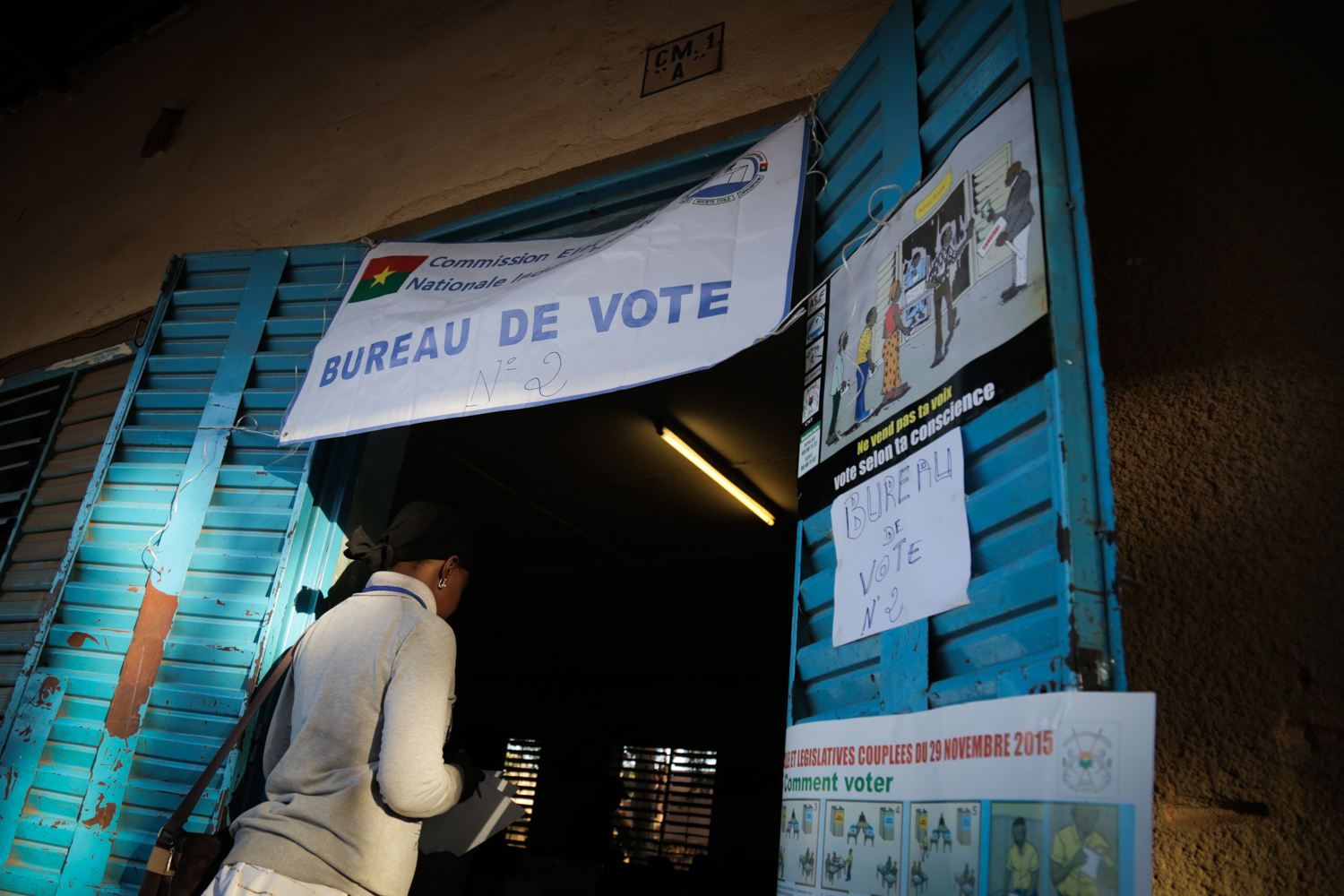

The shutters are painted blue, and someone has written Bureau de vote N° 2 by hand on a sheet of paper, in case the printed banner above the door comes down. A cartoon poster on the right-hand shutter carries a line in capitals: Ne vend pas ta voix, vote selon ta conscience. Don’t sell your vote; vote with your conscience.
This is Ouagadougou on 29 November 2015, the day Burkina Faso held its first national elections since a popular uprising ended Blaise Compaoré’s 27 years in power. In September the presidential guard had attempted a coup, which collapsed within a week. About 60 percent of registered voters turned out, and Roch Marc Christian Kaboré won the presidency in the first round with 53.5 percent of the vote.
Burkina Faso is a majority-Muslim country. In the survey I use, 58 percent of Burkinabè respondents in the fifth round gave their religion as Islam. By the most familiar finding about religion in comparative politics, that should have made a day like this one less likely.
Is there something about Islam that makes democracy harder?
That question is a sharp version of a larger one, which runs through the dissertation this paper belongs to. Are the political habits of a people carried in its culture, so that some societies are better suited to democracy than others? Or are they shaped by the institutions people live under? Religion is a hard test for the second view, because religious identity is among the most durable things a person inherits. Here I move the question down in scale, from the world to countries, to the states of one country, to regions and finally to individual people, to see where the gap between Muslim and Christian societies actually sits.
Part 1 · The puzzle
Why is democracy rarer where Muslims are the majority?
Why is democracy so comparably rare in countries with Muslim majority populations?
The opening line of the paper, October 2016
The pattern is one of the most robust in cross-national research. Countries with larger Muslim shares of the population score lower on the standard measures of democracy, and the gap survives when researchers account for income, oil and gas, education, ethnic diversity, colonial history, gender equality and religious freedom. Five years after the Arab Spring, when I wrote the paper, scholars of democratisation still did not agree on why.
Most political scientists are sceptical of cultural explanations. Many observers, intellectuals and policymakers are not. Francis Fukuyama, writing about Algeria and Iran in 1992, called Islam a “major barrier to democratization”, and Samuel Huntington’s The Clash of Civilizations made a broader version of the case. Those who hold the view point to passages in the Qur’an, and to the popular support that shari’a and Islamist parties hostile to democratic institutions command in many Muslim-majority countries.
The cultural account deserves to be taken seriously, and some evidence seems to fit it. In the studies I draw on, the Muslim-majority states that regulate religion most strictly, such as Saudi Arabia, Sudan, Turkmenistan, Uzbekistan and Qatar, also allowed the least political competition, while more secular or religiously moderate societies such as Turkey, Indonesia, Senegal and Lebanon allowed more. Christianity offers a precedent for religion changing politics. After the Second Vatican Council in the early 1960s, the Catholic Church embraced religious liberty and human rights, and became a force for democratisation in Spain, Poland, Brazil and the Philippines.
Africa has its own version. In Senegal, Mali and Niger, the few Muslim-majority African countries that liberalised or democratised in the early 1990s, the movements for change were led by secular, French-speaking elites in the cities: students, teachers, lawyers and journalists. Clerics and religious groups in Mali and Niger protested against the new regimes, and argued at first that democracy did not suit their societies and was incompatible with Islam. Organised religion in the Muslim world has rarely been the democratising force that many Catholic and Protestant churches were in the third wave of democratisation, in countries such as Malawi, South Africa and Ghana.
So the hypothesis is a serious one. If Muslims are less likely to press for democracy, or more likely to support movements that oppose it, then places with more Muslims should be governed less democratically. Africa shows the familiar pattern between countries. The Afrobarometer, the survey I rely on, asks people how democratic they think their country is.
35 African countries, one survey round
Each dot is a country. Average answer to “how much of a democracy is this country?”, 1 to 4
Afrobarometer round 5, the round used in the paper’s Figure 1 (which also sizes countries by population). Line: unweighted least squares fitted here to the archived country averages.
Each dot is a country in the survey’s fifth round. Across is the share of respondents who are Muslim. Up is the average answer to the question “how much of a democracy is this country today?”, on a scale from 1, not a democracy, to 4, a full democracy.
Countries with more Muslims rate their democracy lower. From no Muslims to all Muslims, the fitted line falls by 0.27 points.
The predicted difference between a wholly Muslim and a wholly non-Muslim country is between a fifth and a quarter of the whole range of national ratings.
A few countries produce most of it. The five Arabic-speaking countries of the north, Egypt, Sudan, Tunisia, Morocco and Algeria, average 2.19. The six Muslim-majority countries south of the Sahara average 2.76, slightly above the 2.73 of the countries without a Muslim majority. Niger and Senegal stand out as democratic overachievers.
Leave out the Arabic-speaking north and the line is flat. That is a hint, not yet a test. Each dot is a whole country, and a country bundles religion together with everything else about it.
Part 2 · The trouble with countries
A country is a bundle
Comparing countries cannot settle the argument, because religion arrives together with other things that also shape political regimes, and I discuss three of them.
The first is oil and gas. Many Muslim-majority countries are rich in petroleum, and not only in the Middle East: Nigeria, Malaysia and Kazakhstan are large exporters too. Oil money pays for large armies and police forces, buys off critics and local elites, and cushions rulers against economic shocks without political concessions. Non-Muslim oil states such as Angola, Venezuela and Russia follow the same pattern.
The second is history. Many Muslim-majority countries were governed for centuries by Islamic empires with unusually durable, well-organised states. Some scholars argue that these states kept civil society weak, held off European colonisation until late in the nineteenth century, and left institutions that resist democratisation to this day. Others point to the waqf, the Islamic religious endowment, and its effect on how institutions developed over the long run.
The third is geopolitics. Fear of revolutions like Iran’s in 1979, and later of Islamist terrorism, led American and European governments to back friendly authoritarian regimes in Egypt, Saudi Arabia, Jordan and Kuwait. Elsewhere the end of the Cold War brought Western pressure for free elections. In much of the Muslim world it brought less of it.
Each of these travels with religion across countries, and there are only a few dozen Muslim-majority states to compare. Statistical controls can do only so much with so few cases.
The way out is to change the unit of comparison. Some explanations are tied to the national state. A foreign government supports a regime, not a province, and an imperial history belongs to the whole state. Other explanations can vary inside a country. Oil fields lie in particular regions, and at the regional level in Africa, oil and gas production is almost unrelated to religion, with a correlation of 0.06. Political culture, if it exists, lives where people live. It should be visible in the regions where Muslims or Christians are the majority.
There is a stronger reason to look at regions. Theories of political culture work from the bottom up. Citizens shape their governments in two ways. One is what they want from government, which I call the preference side. The other is how hard they work to hold officials to account, by following politics, voting, protesting and refusing to cooperate, which I call the accountability side.
Both operate most directly close to home. Most of what citizens experience of the state, in Africa as elsewhere, comes through its most ordinary functions, such as health, roads, schools and policing, delivered locally under imperfect control from the capital. Robert Putnam’s classic study of civic culture in Italy found its effects by comparing regional governments. If an Islamic political culture weakens democracy, it should show up in the regions where Muslims live at least as clearly as it does between countries.
A reasonable objection is that most African regions do not elect their own governments. Only a handful of countries, among them Nigeria, South Africa, Ethiopia and, from 2013, Kenya, have elected regional executives, and about a third have elected regional councils that share power with an appointed governor.
But appointment does not cut the link between citizens and rulers. Some appointed governors depend on strong local coalitions. National elections are administered, and manipulated, locally, and how freely people can meet, speak and organise depends on how coercion is applied on the ground. Cultural theories of democracy have never depended on elections in any case: their proponents apply them to China and the Gulf monarchies.
Part 3 · One country
Nigeria’s north is more Muslim, and rated more democratic
Before the full test, one country shows what the comparison looks like. Nigeria, Africa’s most populous country, is divided between a mostly Muslim north and a mostly Christian south, and its 36 states each elect their own governor. Start with the whole continent.
Africa’s first-level regions
Share of survey respondents who are Muslim
Afrobarometer rounds 2 to 6, 2002 to 2015, averaged by region from the paper’s archived data. Boundaries: Global Administrative Areas (GADM) first-level units joined in the paper’s geographical information system. Grey: not surveyed, or not matched to survey regions. Country outlines: Natural Earth.
Each region is coloured by the share of survey respondents who are Muslim. Muslim regions run across the north, through the Sahel and down the east coast, and many countries are split between Muslim and Christian regions.
Now colour the same regions by how democratic their residents rate their country. This map follows national borders far more than religious ones. Whole countries tend to change colour together.
In Nigeria, the north is overwhelmingly Muslim: 87% of respondents in Sokoto, 93% in Kano. In the southern states east of the Niger river, and in the Niger Delta, almost no one is.
Turn to democracy, and the state rated most democratic is Sokoto, in the far north, at 2.81. The lowest is Bayelsa, in the oil-producing Niger Delta, at 2.05; fewer than 1 percent of its respondents are Muslim.
On average, the 14 states with Muslim majorities rate their democracy at 2.52, and the other 23, including the capital territory, at 2.35.
This fits what students of Nigerian elections had described before I wrote the paper: the northern Muslim states were generally regarded as more democratic on average than the Christian south, and especially than the Niger Delta, where vote buying, violence and political “godfathers” were notorious.
But Nigeria alone proves little. The Delta has oil, which brings its own politics, and in Nigeria, as in Mali, survey teams sometimes had to leave out areas that were too insecure to visit. One country can show what the comparison looks like. The test needs every country at once, comparing each region only with others in the same country.
Part 4 · How the evidence was made
189,000 conversations
I chose Africa for three reasons. The first is the range of religious settings. About 450 million Muslims lived in Africa when I wrote the paper, just under a third of the world’s Muslims and a little under half of all Africans. Some live in Muslim-majority countries in North and West Africa and the Horn. Others form large national minorities in West and East Africa. Most live in communities where they are the local majority, and some are minorities in capital cities and elsewhere.
The second is that African states vary a great deal inside their own borders. Many governments have struggled to project power into their hinterlands, and after independence they ruled different regions in sharply different ways. The experts who code the Varieties of Democracy data agree: of 54 African countries, only 6 have more even election quality across their territory than the world average, and only 14 have more even protection of civil liberties. If religion shaped regional politics, Africa is where it would have room to show.
The third is data. The Afrobarometer interviews nationally representative samples face to face, in the language of the respondent’s choice, with samples drawn region by region. Rounds 2 to 6, from 2002 to 2015, give 189,000 interviews in 36 countries, an average of about 400 people in each of up to 492 regions. Religion matters to the people interviewed. In the sixth round, the average Christian and the average Muslim respondent prayed, read the Bible or the Qur’an, or attended a religious service close to once a day.

The question
Asked of every respondent in every round, 2002 to 2015
Question wording: paper, Appendix G. Kaduna: interviews pooled over Afrobarometer rounds 2 to 6 from the paper’s archived regional data; the dots are drawn in the reported proportions, not as individual records.
Every respondent in every round was asked the same question. I use the average answer in each region as a measure of how democratic political life feels there.
The question asks about the country, because no Afrobarometer question asks about regional democracy. But elections, policing and freedom of speech are experienced locally, and national elections vary a great deal in fraud and violence from one region to another.
Take Kaduna State in northern Nigeria. Across the survey rounds, 733 people were interviewed there. 62 percent said they were Muslim and 33 percent Christian. Their average answer to the democracy question was 2.30.
Every region in the study becomes two numbers like these: its religious composition and its rating.
Can a few hundred interviews per region measure where Muslims live? The Demographic and Health Surveys, run independently, interviewed more than 460,000 women in 223 of the same regions.
The two surveys agree almost perfectly on the Muslim share, with a correlation of .99. For Catholics it is .90, and for Protestants .76.
Part 5 · The test
Hold the country still
If an Islamic political culture weakens democracy, regions with more Muslims should be rated less democratic than other regions of the same country, where the national government, the national history and the foreign alliances are all the same.
492 regions in 36 countries
Each dot is a region, sized by the number of interviews
Region averages pooled over Afrobarometer rounds 2 to 6 from the paper’s archived data. All lines are new, unweighted descriptive fits. Country lines: the 18 countries with at least four regions and a spread of at least 15 points in Muslim share. They are not the paper’s adjusted estimates, which follow.
Here are all 492 regions, with each region’s interviews pooled across rounds. Taken together, regions with more Muslims are rated lower, by 0.25 points from none to all Muslim, almost the same slope as between countries.
That is what a cultural explanation predicts, but this view still mixes countries together. A region in Egypt is being compared with a region in Ghana.
Draw a separate line through each country’s regions. Of the 18 countries whose regions differ enough in religion to draw one, 12 slope upward, with more Muslim regions rated more democratic, and 6 slope downward.
Nigeria is one of the upward lines. Its Muslim north rates its democracy higher than its Christian south, as the map showed.
Now measure each region against its own country: how much more Muslim it is than the national average, and how much more democratic it is rated. The differences between countries drop out, and the dots slide to the centre.
The line now rises: +0.16 across a hundred points of Muslim share.
These are pictures rather than estimates, since regions differ in size, wealth and education, and the same region appears in several survey rounds. My models handle all of that, and add controls for each region’s distance from the capital and the border, its size, whether it contains the capital, its share of the national population, and approval of the president. Here is what they find, one step at a time.
How the estimate changes as the comparison tightens
Difference between a wholly Muslim and a wholly non-Muslim region, democracy rating rescaled 0 to 1, with 95% intervals
Table 1 of the paper: 1,563 observations of regions in survey rounds, 36 countries (models 1 to 6); 734 and 205 regional observations in the World Values Survey and AsiaBarometer. All models control for survey round and presidential approval; models 1 to 6 also control for distance to the capital and the border, region size, capital status and population share; models 3 to 8 compare regions within countries. 95% intervals computed here as ±1.96 reported standard errors. The between-country bar is the descriptive slope in the first chart (−0.27 points on the 1 to 4 scale), converted here to the 0 to 1 scale.
Start with every region in one model, without separating countries. A wholly Muslim region is rated 0.03 lower than a region with no Muslims, on a democracy scale rescaled to run from 0 to 1.
Add one variable, the share of a region’s residents who speak Arabic at home, and the sign flips, to +0.04. Arabic speakers live almost entirely in North Africa. South of the Sahara, even before comparing within countries, regions with more Muslims are not rated less democratic.
If contemporary culture explains anything here, Arab political culture is a likelier candidate than Islamic political culture. There is too little variation in Arabic within countries to test it.
Now compare regions only with others in the same country. The estimate is +0.03, and statistically clear: regions with more Muslims are rated slightly more democratic than other regions of their own country.
Account for education, poverty and the share of people living in towns, and it falls to +0.01, indistinguishable from zero.
Adding oil and gas fields and diamond deposits leaves it at +0.01. Comparing regions where Muslims are the largest group with the rest, instead of using their share, gives 0.00.
Two other surveys allow the same comparison in countries with large Muslim minorities, such as India, China, the Philippines and Thailand, and in religiously mixed Muslim-majority countries such as Indonesia, Bangladesh and Malaysia.
The World Values Survey gives +0.03 and the AsiaBarometer 0.00. Their intervals are wide, but neither shows a deficit.
For a sense of size, put the slope between African countries on the same scale: −0.09. The preferred estimate within countries is +0.01, with an interval from −0.01 to +0.03. Even its least favourable end is about a ninth of the gap between countries.
On the original 1 to 4 scale, +0.01 is about 0.03 points.
One variable that predicts higher ratings everywhere
In every regional model, the share of people who say they have no religion goes with higher democracy ratings. That is not evidence that Christianity helps democracy. The regions with the most irreligious respondents are all in Christian or other non-Muslim areas, such as Botswana, Madagascar and Cape Verde, and I leave the reason open. Leaving Islam may be costlier than leaving other faiths, or people may sort themselves by where they move.
Part 6 · The political culture test
Muslims want democracy as much, and know more about who governs
The regional result could still mislead in two ways. Muslims might grade the same government more generously, perhaps because they compare it with governments elsewhere in the Muslim world. Or the theory could be right about people and wrong about places. The interviews can check both, by comparing Muslims and Christians who live in the same region, under the same local officials.
Muslims compared with Christians living in the same region
Difference in percentage points. All but the first two rows hold education, poverty and urban residence equal
Filled dot: statistically significant at 5%; dot in a ring: at 10%; open: not significant. The local government estimate (+4) has p = 0.11. Tables 2 and 4 of the paper, region fixed effects, Afrobarometer rounds 2 to 6; samples range from 19,061 to 160,249 respondents. Standard errors are reported to two decimals, several as 0.00, so intervals are not drawn.
Within the same country, Muslims rate democracy two points higher than Christians on a 0 to 100 scale, and within the same region one point higher. Compare people of similar education, poverty and urban residence and the difference is zero. Within almost 3,000 districts it is one point the other way, so Muslims are not more forgiving judges.
The accountability side of political culture asks whether people follow politics closely enough to hold officials to account. Muslims are one point more interested in politics than Christians in the same region, six points more likely to name the deputy president and two points more likely to name their member of parliament.
The estimate for naming the head of local government, four points, falls just short of conventional significance.
The preference side asks what people want from government. Muslims support democracy exactly as much as their Christian neighbours, and reject one-party rule, military rule and strongmen just as firmly.
One measure points the other way. Asked in the sixth round whether they would mind having neighbours of a different religion, Muslims were one point less accepting, a difference significant only at the 10 percent level. It is small, but it comes up again below.
Put together, the theory of political culture that motivated the test predicts, if anything, that Muslim-majority regions should be slightly more democratic, because their residents watch their rulers at least as closely and want the same kind of government. The reason there is no regional democracy gap is simple. On the measures the theory says matter, Muslims do not carry a distinct political culture.
Part 7 · The qualification
Religious minorities give a less comfortable answer
A regional average is mostly the majority’s view. The people best placed to see whether a region is governed democratically for everyone may be those who do not share its majority religion. So I rebuild the rating from local religious minorities alone: Christians in Muslim-majority regions, Muslims in Christian-majority ones, and people of other faiths or none wherever they are outnumbered.
Pooling all rounds, 274 regions in 31 countries have more than 15 such respondents. Almost all of North Africa drops out, because its regions are so uniformly Muslim. The minorities’ ratings track everyone else’s closely, with a correlation of .90.
Who is asked changes the answer
Regions with more Muslims compared with regions with fewer in the same country, democracy rating 0 to 1, with 95% intervals
Table 3 of the paper. Regions where more than 15 respondents across all rounds do not belong to the region’s largest religion: 274 regions in 31 countries, almost none of them in North Africa. Country fixed effects, presidential approval, living conditions, natural resources and the region’s place in the country held constant. 95% intervals computed here as ±1.96 reported standard errors.
In these 274 regions, using everyone’s answers, regions with more Muslims are rated no differently from other regions of the same country: −0.01.
Using only the minorities’ answers, the estimate is −0.06 for the Muslim share and −0.04 for a Muslim plurality, between a third and a half of a standard deviation, and both are statistically significant.
Religious minorities in Muslim-majority regions see less democracy than religious minorities in Christian-majority regions of the same country.
Minorities’ ratings of electoral integrity and political freedom show the same pattern. Their reports of local corruption and bribes do not. I read this as a possible problem with the democratic accommodation of religious minorities, likely connected to the much greater religious uniformity of Muslim-majority regions.
In northern Nigeria and on the semi-autonomous Zanzibar islands of Tanzania, shari’a has been applied to family law, criminal law, inheritance, gambling, alcohol and dress. There have been reports of persecution of Christians in Kenya, Mali, Senegal and The Gambia, and more widely in the Horn of Africa and North Africa. And as the last chart showed, Muslims are slightly less accepting of neighbours of another faith.
There are reasons for caution. Minority samples are small, so their ratings are noisier, and the comparison is between minorities living under different majorities, not between minorities and majorities. But the result should not be explained away. A region can be governed as democratically as its neighbours for most of its residents, and less so for some.
Part 8 · Back to the world
The gap begins somewhere above the region
As for the question I started with, where ordinary citizens meet the state, regions with more Muslims are governed about as democratically as regions with fewer, by the judgement of the people who live there. Muslims judge their governments as critically as Christians do, watch them at least as closely, and want democracy as much. Cross-country comparisons, and many policymakers, attribute part of the democracy gap to the political culture of ordinary Muslims. The evidence from African regions suggests that direct effect is overestimated.
That does not make religion irrelevant to democracy in Muslim-majority countries. If the national pattern is not spurious, it seems to operate at the level of the state. It may run through the legacy of rule by Islamic empires, through Western support for authoritarian governments that are not Islamist, or through national religious organisations.
The Christian contrast may be organisational more than cultural. Churches are hierarchical organisations that can concentrate their efforts on national political reform, as the Catholic Church did after the Second Vatican Council, whatever the values of individual believers. And the Sykes–Picot Agreement of 1916, the partition of the Ottoman Empire and the territorial gains of the Islamic State are reminders that many states in the Muslim world have artificial borders, and an uncertain hold on loyalties that also run to the wider community of Muslims, the ummah.
Africa may not generalise. Islam spread in much of Africa through Sufi brotherhoods organised around individual preachers, which blended Islamic teaching with older local practice, and in Europe and the United States Sufism is often seen as a tolerant form of the faith. But the evidence from South and Southeast Asia points the same way, and the Middle East and North Africa, where Salafism has the most sway, are home to less than a fifth of the world’s Muslims. The African experience may be closer to the typical Muslim experience than the Middle Eastern one is.
This matters now because the belief that Muslims as a group carry a political culture unsuited to democracy still shapes arguments about immigration in Europe and North America, and about policy towards the Middle East and the Sahel. The paper cannot settle those arguments, since it covers perceptions in African regions between 2002 and 2015. What it shows is narrower and more useful. When Muslims and Christians live under the same local institutions, they judge those institutions alike, want the same kind of government, and know at least as much about who governs them.
For anyone who wants more democracy in Muslim-majority countries, the evidence points to states: their histories, their resources, their alliances, and how they treat the people who do not share the majority faith. Elsewhere in the dissertation, culture follows institutions in the same way. On the Danish–German border, trust converged within two generations of a change of state. In African regions, the most inherited of identities makes little difference to how people judge, watch and want the governments closest to them.
Where does the so-called “Islamic democratic deficit” come from? Seemingly not from Islamic political culture, but from state-level factors.